
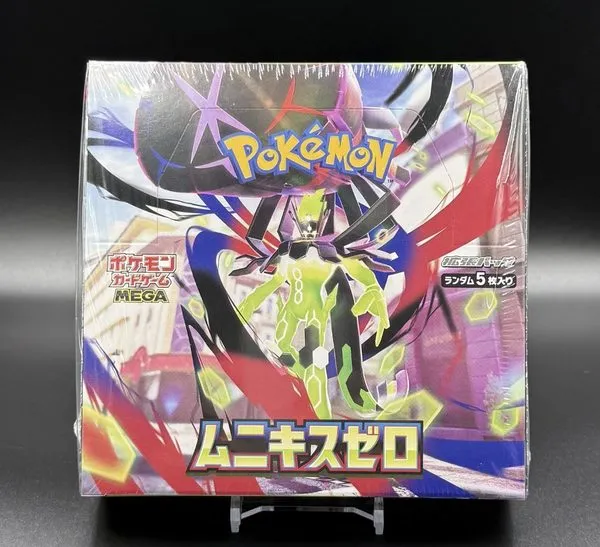
Japanese Pokémon cards wholesale means buying Japanese-language Pokémon TCG products from a supplier for resale, distribution or store replenishment. The right sourcing process checks the exact set, sealed condition, MOQ, landed cost, lead time and documentation before payment.
Quick answer: For a first order, shortlist the Japanese products with the clearest set identity—such as M2a Mega Dream ex, M2 Inferno X, M6 Storm Jade or SV11W White Flare—then request a written quote that separates product, shipping and any applicable charges.
Current catalog snapshot
| Signal | Catalog finding | Why it matters |
|---|---|---|
| Japanese-version SKUs | 42 | Enough breadth to test several set themes |
| Booster-box products | 25 | A clear wholesale category beyond single cards |
| Gift-box products | 111 | Useful for gift, collector and specialty retail channels |
The figures above are a September 2026 catalog snapshot, not a promise of live inventory. Availability, price and lead time should be reconfirmed in the quotation.
What does Japanese Pokémon cards wholesale include?
Japanese Pokémon cards wholesale is a B2B purchasing category covering sealed booster boxes, gift boxes, collection products, Elite Trainer Boxes and related collectibles. It does not automatically mean every item is a standard booster box or that every supplier holds stock locally. In our catalog review, Japanese products appear across M2/M2a, M3, M4, M5, M6, SV8, SV8a and SV11W series, with different formats and packaging. That distinction matters because a retailer comparing an M2a Mega Dream ex booster box with an M2 Inferno X gift box is comparing different shelf units, price points and customer use cases. Use the wholesale catalog to filter by Japanese language, product type and series. For set naming, cross-check the official Pokémon TCG site and the official Japanese Pokémon Card site. (A clean product taxonomy saves more time than a long supplier list.)
Which Japanese product formats should a buyer test first?
Product format is the unit a buyer should evaluate before choosing quantity, because a booster box, gift box and Elite Trainer Box serve different retail purposes. Our catalog review found 25 Japanese booster-box products alongside a much larger gift-box range, so a sensible test order can mix one repeatable core format with one themed format. Booster boxes are easier to compare across sets and often fit hobby-store replenishment. Gift boxes can support seasonal displays, collector bundles or higher visual merchandising value. Products such as M2a Mega Dream ex, M6 Storm Jade and SV11W White Flare should be quoted with the exact format in the line item—not just the set name. Create a simple Google Sheets test matrix with SKU, format, units, target retail price, expected margin and sell-through date. Then use the live product catalog to review available booster-box and gift-box formats before requesting a quote.
How should you evaluate a Japanese Pokémon card supplier?
Supplier evaluation is a documented comparison of identity, condition, availability and commercial terms—not a decision based on a low headline price. In our review of the catalog, several products use similar set names across multiple gift-box listings; that makes SKU-level confirmation essential. Ask each supplier to provide the Japanese product name, set code, product format, language, quantity available, seal description, packing method, MOQ, lead time and quote validity. Request current photos when the product is sensitive to packaging or edition. Compare the answer for an M2 Inferno X box with the answer for an SV11W White Flare box; a supplier who answers one clearly should answer both clearly. Keep the evidence in a shared Google Drive folder and record unresolved points before approval. Use the live contact page to send the SKU list and unresolved questions to the sourcing team. Do not describe a product as “official,” “licensed” or “factory sealed” unless the supplier can support that wording.
How do MOQ and wholesale pricing work?
MOQ is the minimum quantity a supplier will accept for a specific SKU, format or quotation—not a universal rule for every Japanese Pokémon product. MOQ varies by product and quotation, so buyers should request the current minimum quantity rather than treat a catalog value as a guaranteed commercial term. Request two quote levels: a small test order and a repeat-order quantity. Ask the supplier to separate unit price, carton or packing charges, domestic handling, international freight and any taxes or duties that apply to your destination. For example, compare the landed cost of ten M2a Mega Dream ex boxes with a mixed order containing M2 Inferno X and M6 Storm Jade. Use a spreadsheet formula for landed cost per sellable unit, then compare it with your channel margin. Use the live quote request page to submit the target quantity and destination. Never treat a marketplace price as a final delivered price.
How can you verify language, edition and sealed condition?
Verification is the step that confirms the item a buyer ordered is the item a supplier quoted. Our catalog review shows Japanese and Chinese products with similar visual naming, so “Pokémon box” is not a sufficient specification. Match the product title, language, set code, format, quantity and packaging description across the quotation, product page and pre-shipment photos. For Japanese items, compare the set terminology with the official Pokémon Card Japan information. Ask whether “sealed” refers to the individual box, an outer carton or only the manufacturer packaging, and ask for clarification when the answer is ambiguous. A buyer can use M2a Mega Dream ex as a checklist example: language Japanese, format booster box or gift box, quantity per carton, seal status and SKU should each be explicit. Keep a photo record for the first shipment and inspect corner damage, shrink wrap and labels on arrival. If the product differs, pause repeat ordering until the discrepancy is resolved in writing.
What shipping and documentation should be confirmed?
Shipping documentation is the written handoff between a confirmed product order and a deliverable shipment. Lead time is reviewed after the product, quantity and destination are submitted, and it does not replace confirmation of handling time, carrier, carton dimensions or customs responsibility. Ask for the shipping origin, Incoterm or delivery basis, tracking method, carton count, gross weight and packing protection. Confirm whether the invoice lists the correct product description and whether your destination requires import registration, product labeling or tax documentation. For a card shop receiving M6 Storm Jade or SV11W White Flare, carton protection can matter as much as transit speed because crushed packaging affects resale presentation. Keep the final packing list with the purchase order and use the live contact page for shipment questions. External customs rules vary by country, so check your own customs authority before payment. A clear document trail also makes claims easier if a carton arrives damaged or incomplete.
How do you turn a first order into repeat supply?
Repeat supply is a replenishment process built from sell-through data, not an automatic result of placing one successful order. Our catalog review suggests starting with a small group of recognizable Japanese sets, then measuring units sold, days to sell, customer questions, damage rate and reorder timing. After the first shipment, record the exact SKU and format that moved—such as an M2a Mega Dream ex booster box rather than the broader “M2” label. Share a reorder brief containing the previous invoice, accepted photos, target quantity, required delivery window and any packaging feedback. Ask the supplier to confirm whether the same edition and language remain available before you advertise a restock. Use the live product catalog as the main internal link, with individual product pages linked beneath it. A repeat order should also include a freshness check for price, stock and lead time. (The boring checklist is what protects the exciting launch.)
Buyer checklist before sending payment
- Confirm the exact Japanese set name, set code and product format.
- Confirm quantity, MOQ, unit price and quote validity.
- Confirm seal condition, current photos and packing method.
- Calculate landed cost, including freight and destination charges.
- Confirm lead time, carrier, tracking and carton details.
- Check local import, tax and labeling requirements.
- Keep the quotation, invoice and product evidence together.
- Approve repeat ordering only after the first shipment matches the specification.
FAQ
Where can I buy Japanese Pokémon cards wholesale?
Start with a supplier that can provide SKU-level product identity, availability, MOQ, lead time, seal description and a written quote. Use the TGCNEX catalog to shortlist products, then request confirmation before payment.
What is the usual MOQ for Japanese Pokémon cards wholesale?
MOQ depends on the SKU and supplier. Some catalog items may be quoted from one box, while repeat or mixed orders can have different terms. Always confirm the MOQ in writing.
How do I verify a Japanese Pokémon booster box?
Match the Japanese set name, format, SKU, seal description, quantity and photos against the quotation and official Pokémon Card information. Inspect the first shipment before scaling.
Are Japanese Pokémon cards a good fit for card shops?
They may fit shops serving collectors and TCG players, but the decision should be based on local demand, landed cost, sell-through and import requirements—not language alone.
What should I include in a wholesale inquiry?
Include product names or SKUs, language, format, target quantity, destination country, preferred shipping method and required delivery window. This gives the supplier enough context to prepare a useful quote.
Next step: Request a Japanese Pokémon cards wholesale quote with your target sets, quantities and destination.